
होमWorld CricketFrom 5/4 to 221/7: Omarzai's 116-Run Blitz Seals Afghanistan's 19-Run Win and 2-0 Series
From 5/4 to 221/7: Omarzai's 116-Run Blitz Seals Afghanistan's 19-Run Win and 2-0 Series
अफ़ग़ानिस्तान ने शारजाह में ज़िम्बाब्वे को 19 रन से हराकर T20I सीरीज़ 2-0 से जीत ली। अफ़ग़ानिस्तान ने 221/7 बनाया, जिसमें अज़मतुल्लाह ओमरज़ई की 50 गेंदों पर 116 रन की पारी (12 छक्के, 44 गेंदों पर शतक) और इजाज़ अहमद अहमदज़ई के साथ 142 रन की रिकॉर्ड छठी विकेट साझेदारी शामिल रही। टीम एक समय 5/4 पर सिमटी थी। जवाब में ज़िम्बाब्वे 202/5 ही बना सका; सिकंदर रज़ा ने 40 वर्ष की उम्र में 106* रन बनाए और तफ़ादज़्वा सिगा के साथ 120 रन की अटूट साझेदारी निभाई। रशीद खान पुरुष T20I में 200 विकेट लेने वाले पहले गेंदबाज़ बने।
At Sharjah, Afghanistan beat Zimbabwe by 19 runs to seal the three-match T20I series 2-0 with a game to spare. Batting first, Afghanistan posted 221 for 7, and Zimbabwe could only reach 202 for 5 in reply. On the face of it, that looks like a routine high-scoring contest, but the real story lies in the first four overs, when Afghanistan were 5 for 4.
In cricket, such a start usually signals defeat. In T20I cricket, the powerplay is the most fragile phase, and Afghanistan lost their first four wickets inside it. By the time the fifth wicket fell, the score was just 38. On a ground like Sharjah, where the ball comes nicely on to the bat, that position is close to hopeless. But Afghanistan had Azmatullah Omarzai, and he turned that position into history.
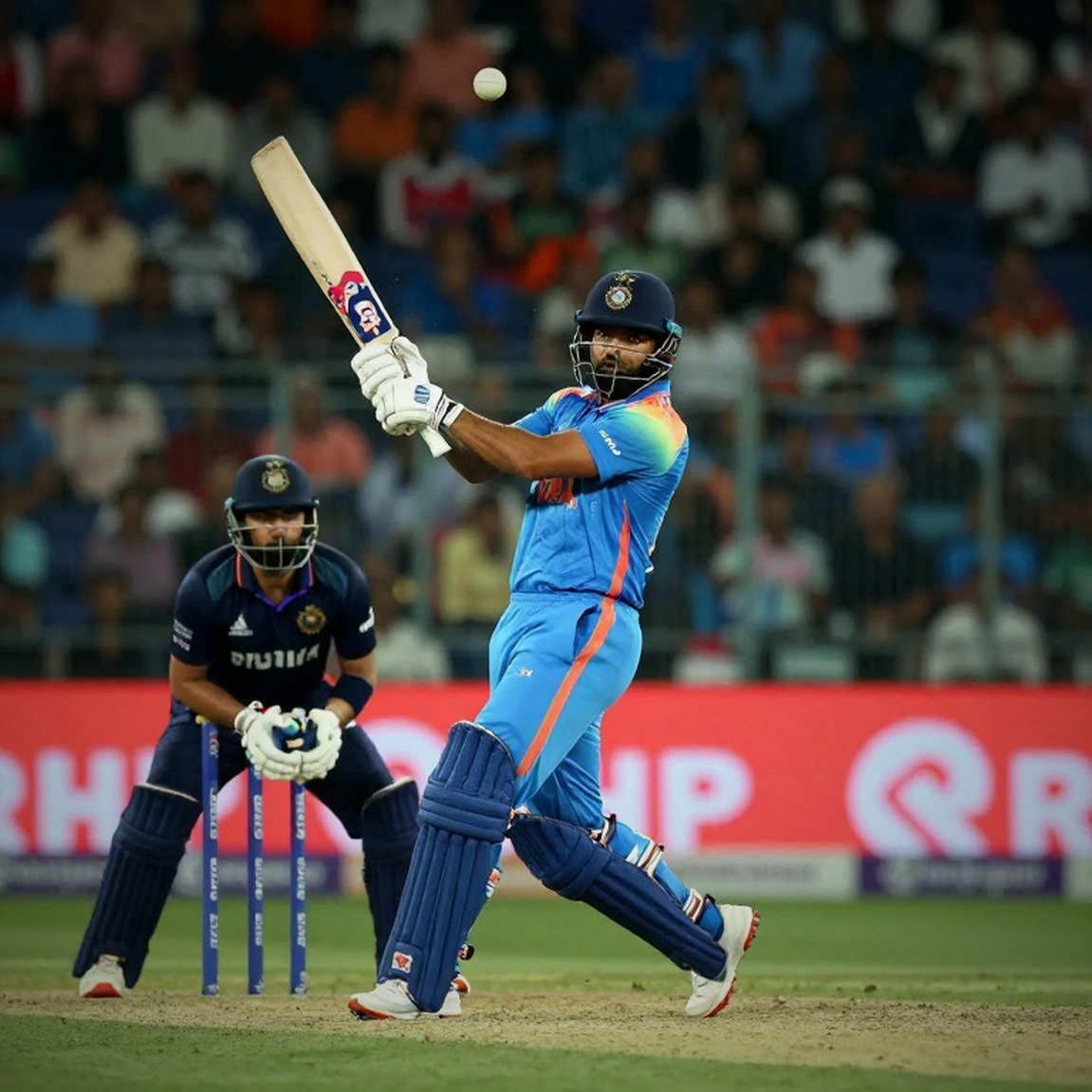
Omarzai made 116 off 50 balls at a strike rate of 232, hitting 12 sixes. His century came off just 44 balls and was his maiden T20I hundred. The innings that began at 5 for 4 ended up carrying the team to 221. Omarzai contributed with the ball too, taking the wicket of Innocent Kaia. In a match where the batting unit was collapsing, the all-rounder's performance proved to be the single most decisive factor.
Alongside him, Ijaz Ahmad Ahmadzai made 52 off 27 balls at a strike rate of 192.6. The two shared a 142-run stand for the sixth wicket, the highest for the sixth wicket or lower in T20I history. That partnership did not just rescue the team, it changed the direction of the match. Ijaz had also scored a fifty in the series opener, making this his second consecutive half-century, though the sample is far too small to conclude that he has permanently found form or undergone a technical transformation.
The second major number from Afghanistan's innings is 176 runs in the last ten overs, including 65 in the final three. That phase effectively put the target beyond Zimbabwe's reach. At Sharjah, balls were flying out of the ground and replacement balls had to be used during the match. This suggests the pitch was extremely batting-friendly and the boundaries were short. In such conditions, 221 was a strong total but not an untouchable one. Zimbabwe had a chance to chase it down, provided they did not lose early wickets.
In the closing part of Afghanistan's innings, Rashid Khan made 25 off 6 balls at a strike rate of 416.7. It was a short cameo, but it showed that the lower order can also score quickly. In the same match, Rashid became the first bowler to reach 200 wickets in men's T20I cricket. That milestone is not the product of one match but of long-term consistency and cannot be viewed with the same small-sample scepticism.
Zimbabwe's chase began better than expected. They exploited the new ball and managed to dismiss Afghanistan's top order cheaply. But wickets kept falling through the middle order, and by the halfway stage the score was 82 for 5. Chasing 221 while losing five wickets in ten overs virtually settles the direction of a match. At that point Zimbabwe needed both a high run rate and wicket preservation, which is almost impossible to combine.
Under that pressure, Sikandar Raza played the second big innings of the match. He made 106 not out off 56 balls at a strike rate of 189.3, becoming the oldest man to score a T20I century at the age of 40. The achievement is remarkable in itself, given that the format demands the most in terms of speed and reflexes. Raza kept his team in the match almost single-handedly, but it is also true that he found no support at the start of his innings.
He was joined by Tafadzwa Tsiga, and the two put on an unbroken 120-run stand. That partnership reduced the margin of defeat and gave Zimbabwe a respectable position, but it could not close the gap. Tsiga and Vincent Masekesa were both making their debuts in this match. Tsiga's partnership is a positive sign, while Masekesa was attacked heavily by Afghanistan's batsmen. It shows that Zimbabwe are attempting a selection transition, but their immediate options remain thin.
In bowling terms, Zimbabwe's story was one of sharp swings. Kundai Matigimu bowled a double-wicket maiden at the start, reducing Afghanistan to 5 for 4, which is a superb opening spell in T20I cricket. But the same bowler's final over proved extremely expensive. Brad Evans conceded 27 runs in his last over. That was the real difference in the match: while the new-ball plan worked, the death-over execution fell apart completely.
This weakness is not just about one match but points to a structural problem. In T20I cricket, restricting runs in the last five overs is the hardest task, and Zimbabwe failed there repeatedly. Yorkers, slower balls and holding line and length under pressure, the team fell short on all three counts. The result was that an innings that had been reduced to 38 for 5 reached 221. Had Zimbabwe conceded 40 to 50 fewer runs at the death, Raza's innings could have turned into a winning one.
For Afghanistan, this win is satisfying on many counts, but it also carries a warning. Losing four wickets for 5 runs inside four overs is not a normal occurrence and cannot be fixed by lower-order heroics every time. Against stronger new-ball attacks, the same top order could prove costly. The team's strength lies in its depth: the variety of Rashid Khan, Mujeeb Ur Rahman, Fareed Ahmad, Omarzai and Abdollah, plus the hitting ability of the lower order. But that strength only matters if the top order provides at least a foundation.
Sharjah is effectively an adopted home base for Afghanistan cricket. The conditions, the size of the boundaries and the batting-friendly surface are familiar to the team. For Zimbabwe, it was effectively a foreign or neutral venue. That has a bearing on the match data, though the source does not state the toss details, so it cannot be assessed directly. Even so, a home team naturally holds a psychological edge in such conditions.
The series result also means Afghanistan have made the lead unassailable with a match to spare. That matters for a team that is steadily building its T20I credentials. For Zimbabwe, this series is a learning opportunity. Given Raza's age, it is clear that the team must develop permanent middle-order options, otherwise every match will rest on one individual.
At the analytical level, one point is essential: the numbers from this match are spectacular, but they come from a single game. To say Omarzai is now among the world's top T20 finishers would be premature. His full bowling data is also unavailable. Similarly, Ijaz's back-to-back fifties are encouraging, but a firm technical judgement will require the next few innings. Raza's century at 40 is exceptional, but the age-curve risk remains.
The biggest lesson from this match is that in T20 cricket, the scoreline never tells the whole story. Looking at 221 for 7 against 202 for 5, it would seem one-sided, whereas in reality Afghanistan looked out of the match for four overs and Zimbabwe were struggling at 82 for 5 at halfway. The weaknesses of both teams are visible in that scoreline: one team's top order, the other's death bowling.
Afghanistan's next challenge will be not to let this win hide their structural weakness. Work on the powerplay plan is necessary, because the lower order will not rescue the team every time. For Zimbabwe, the direction of improvement is clear: better use of yorkers and slower balls at the death, and the development of batsmen other than Raza to take responsibility in the middle order.
The third and final match of the series is now largely a formality, but it remains a test for both teams. Afghanistan will look to give their top order stability, while Zimbabwe may consider giving their debutants more opportunities to build for the future.
In summary, this Sharjah contest will be remembered for Azmatullah Omarzai's 116-run innings, his record 142-run stand with Ijaz Ahmad Ahmadzai, Rashid Khan's 200th T20I wicket and Sikandar Raza's century at the age of 40. But it will also be remembered that Afghanistan were 5 for 4 and Zimbabwe were 82 for 5 at halfway. That contrast is what makes this more than an ordinary win. (Match figures are based on the scorecard details available.)

संबंधित खिलाड़ी
अनुशंसित
Test Hundreds From No.9 Or Below: The Rarest Scorecard Line Is Really A Story About The Top Order2026-10-25
Christchurch T20I: India Go 2-0 Up as Tilak Varma and Nitish Kumar Reddy Convert the Final Over — and the Middle Overs Nobody Counted2026-10-25
Rashid Khan's No.1 Chair Has a Paper Trail. Shai Hope's Centuries Have No Date.2026-10-30
WBBL 2026: Thirty-Eight Days, Forty-Three Matches, and the Ledger That Begins With a Squad List2026-10-29
Smith Is Available, but Australia’s Real Opponent Is the Clock: A Document Read of the Gqeberha Test2026-10-30
अनुशंसित
India's 2-0 lead was written in the second and third overs, not the last one2026-10-25
India Don't Need Another Hardik Pandya — They Need Ten Overs2026-10-29
Smith's Neck, Cummins's Faith and the Morning Newlands Is Asking About2026-10-27
Mirpur, Day One: Shadman's 99* and the Empty Space on the Scorecard2026-10-29
WBBL Match 3: Sixers' Field-First Call, the Overseas-Quota Arithmetic and an Unresolved 08:102026-10-31