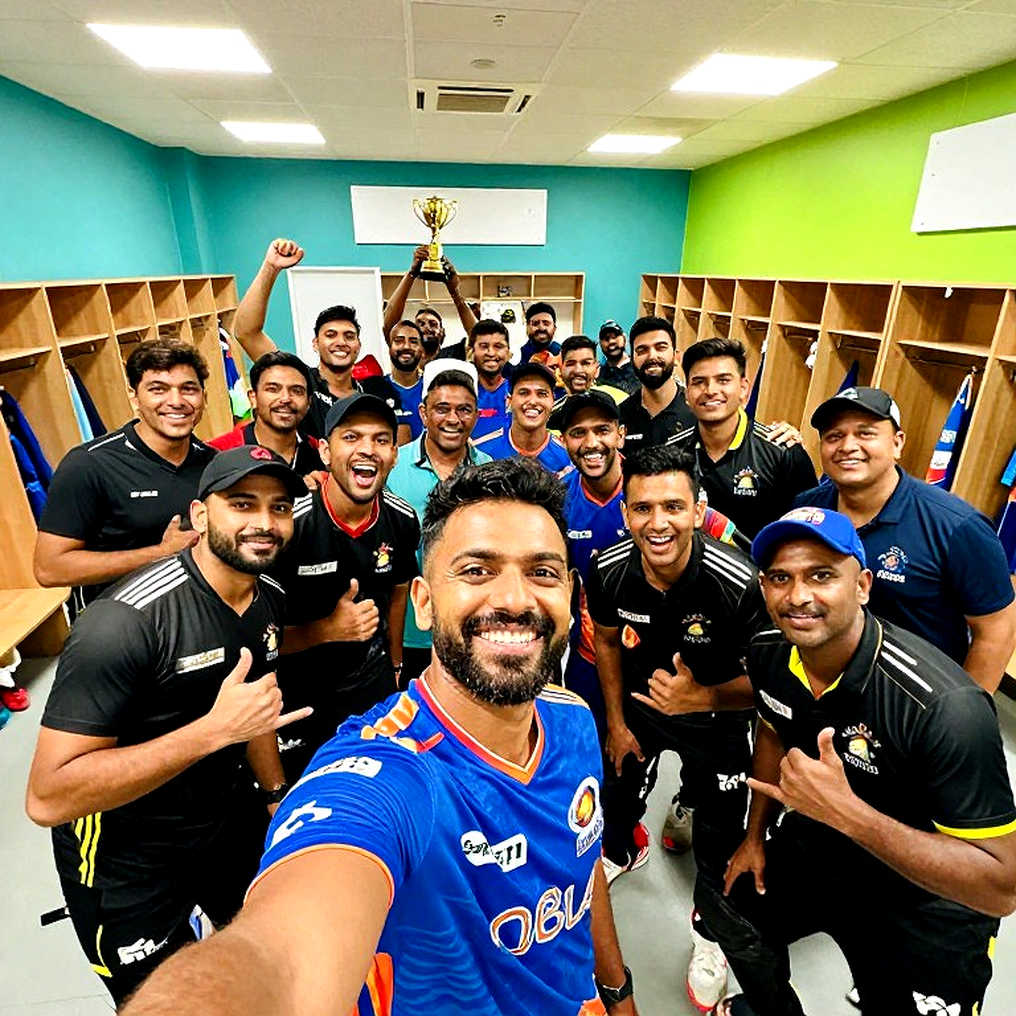
Namibia Make History: Beat Ireland 3-2 to Claim First-Ever Bilateral ODI Series Win Over a Full Member
नामीबिया ने विंडहोक में खेली गई पांच मैचों की वनडे सीरीज़ 3-2 से जीती। निर्णायक पांचवें वनडे में आयरलैंड 129 रन पर ढेर हो गया और नामीबिया ने पांच विकेट से लक्ष्य हासिल किया। जे.जे. स्मिथ ने 4/20 लिया और स्मिथ-जैक ब्रैसेल ने मिलकर सात विकेट झटके; आयरलैंड के केवल चार बल्लेबाज़ दोहरे अंक तक पहुंचे। सीरीज़ के सर्वश्रेष्ठ खिलाड़ी गेरहार्ड एरास्मस रहे—263 रन और चार विकेट। मैच क्रम: आयरलैंड, नामीबिया, नामीबिया, आयरलैंड, नामीबिया। यह किसी फुल मेंबर के खिलाफ नामीबिया की पहली द्विपक्षीय वनडे सीरीज़ जीत बताई जा रही है (स्वतंत्र सत्यापन आवश्यक)। 2027 विश्व कप की सह-मेज़बानी दक्षिण अफ्रीका, ज़िम्बाब्वे और नामीबिया के पास है; आयरलैंड को वनडे रैंकिंग से सीधा प्रवेश माना जा रहा है जबकि नामीबिया को प्ले-ऑफ मार्ग पर निर्भर बताया गया है—ये पूर्वानुमान हैं, पुष्ट तथ्य नहीं।
Windhoek: Namibia beat Ireland 3-2 in the five-match ODI series, winning the deciding fifth ODI by five wickets. This is not merely a series win. It is the first bilateral ODI series victory in Namibia's history against a Full Member nation. Every match of the series was played in Windhoek, at home, in front of home crowds.
The significance grows because the 2027 Men's Cricket World Cup will be co-hosted by South Africa, Zimbabwe and Namibia. Namibia is therefore appearing not just as a co-host but as a team capable of absorbing pressure on big occasions. A series win against Ireland strengthens the argument that Namibia's level is no longer confined to being 'the best among Associate nations'.
Fifth ODI: Ireland bowled out for 129
In the decider, Ireland's innings collapsed entirely and the whole side was bowled out for 129. The standout bowler for Namibia was JJ Smith, who took four wickets for 20 runs. Smith and Jack Brassell took seven wickets between them, and that is the central story of the collapse.
The clearest sign of Ireland's batting fragility was that only four batters reached double figures across the entire innings. At a total of 129, that figure shows the spine of the team broke early and the lower order could not hold it together. Namibia's bowlers did not just take early wickets; they sustained pressure through the middle overs, so Ireland never moved towards a substantial score.
The chase was not straightforward
The target was 130, but Namibia reached it with five wickets down. That means it was not a one-sided chase. Ireland's bowlers kept Namibia under pressure too, and had another wicket or two fallen early, the contest could have stretched into the final overs. Namibia will be relieved that the middle order stayed calm and closed in on the target without undue risk.
There is another aspect to this chase: even 129 was not an easy target. The Windhoek pitch was offering help to the seamers, as Smith's 4/20 and the combined tally of seven wickets suggest. Given that, Namibia's batting deserves credit for keeping the match under control despite losing five wickets.
Erasmus named Player of the Series
Gerhard Erasmus was named Player of the Series. Across five matches he scored 263 runs and also took four wickets. That is an all-round contribution that serves the team in two ways: making runs with the bat and delivering important breakthroughs with the ball.
A total of 263 runs works out to an average of roughly 52.6 across five matches. That consistency suggests Erasmus can be relied upon in pressure situations. However, the available information does not say how many of those 263 runs came in half-centuries or hundreds, which innings came at decisive moments in the series, or in which matches the four wickets were impactful. That is a gap that limits any assessment of the Player of the Series to bare numbers.
The Ireland captain's response
Ireland captain Lorcan Tucker spoke candidly about the defeat. He called it a 'disappointing day' and acknowledged that the team did not bat at the required 'skills level'. He stated clearly that credit goes to Namibia, who played better under pressure.
There is a nuance worth noting here. Tucker's actual language was measured and professional. What was presented in sharper terms as 'bitter disappointment' seems to owe more to the summariser's colouring than to the speaker's tone. That does not change the fact that the team was hurt by the loss, but it is a reminder that quotes should be read in their original register.
One significant imbalance runs through this series coverage: there is no statement from any player or coach on the winning side. There is no direct quote from Erasmus, the captain, or the Namibia cricket board. The result is that the most vivid and most extensive reaction available to the reader comes from the captain of the losing team. On one side the story belongs to Namibia; on the other the voice belongs to Ireland.
The swings of the series
The sequence shows this was no one-sided win. Ireland won the first ODI, Namibia the second and third, Ireland the fourth, and Namibia the fifth. That is, the series reached 2-2 before Namibia seized the decider.
But here is something any reader will notice: Ireland won the fourth ODI by a massive 130-run margin, and in the very next match that same side was bowled out for 129. No clear explanation is offered for such a dramatic swing. It could be the effect of pitch conditions, team rotation, the return or absence of injured players, or a psychological failure to reach the right 'skills level' in the decider. Until one of those causes is confirmed, the swing remains an open question.
What this means for Namibian cricket
Namibia has long been regarded as one of the stronger teams among Associate nations. It has regularly secured places at major events such as World Cups and qualifiers, and it has produced notable performances against bigger teams on several occasions. But winning a bilateral series against a Full Member is a different order of achievement, because it demands consistency, a similar standard across three or five matches, and the ability to make decisions under pressure.
Namibia's real strength in this series was that it bounced back immediately after a heavy defeat in the fourth ODI. Bowling Ireland out for 129 in the decider, having lost by 130 runs in the previous match, is a sign of mental resilience.
The 2027 World Cup and the qualification equation
The 2027 World Cup will be co-hosted by South Africa, Zimbabwe and Namibia. As a co-host, Namibia will play on home grounds, and this series is an important step in that preparation. When a team beats a Full Member at home, the confidence gained has a distinct value.
For Ireland, the path is comparatively clear: it is understood to be in a position to secure direct World Cup qualification through the ODI rankings. For Namibia, the route is described as longer and more complicated, potentially involving the Qualifier Play-off.
It is important to state clearly that these qualification points belong in the realm of prediction, not confirmed information. They depend on what the ICC qualification regulations say at the time, where the teams stand in the rankings, and which qualifiers are staged. No team's place should be treated as 'already secured' on the basis of this report.
A warning for Ireland
This series leaves Ireland with several questions. The top order stumbled badly in two matches, and winning one match by 130 runs and then folding for 129 in the next is a clear signal of instability. Captain Tucker himself acknowledged that the team did not perform to expectations at a skills level.
That does not mean Ireland is a weak side. It means that abroad, in less familiar conditions, when the opposition applies pressure, Ireland's middle order does not consistently hold up. Across a full series that gap became visible, and it is a lesson for teams building a strategy around reaching major tournaments via the ODI rankings.
What this report does not contain
The report does not give match dates or the series window. The venue 'Windhoek' is listed for all five matches, but not the dates, which makes it hard to place in the ICC calendar.
Second, the bowling figures are incomplete. Smith's 4/20 is clear, but Brassell's wickets are not stated separately; the report only says the two took seven wickets between them. In addition, it says only four batters reached double figures in the 129, but does not give individual scores.
Third, and most importantly, there is no reaction from Namibia. Erasmus won the Player of the Series award, but his words are absent. There is nothing from the team captain, nothing from the coach, nothing from the board. In a historic win where the home team is the protagonist, its voice is entirely missing.
The road ahead
For Namibia, the next step is to prove that this win is part of a development curve rather than an outlier. Winning at home is a beginning; repeating it away from home, in different conditions against Full Member teams, is the next test.
For Ireland, this series is a subject for review. The distance between a 130-run win and being bowled out for 129 is too large to be dismissed as a 'bad day'. Batting plans, middle-order stability and adaptation to overseas conditions all need revisiting.
Editorial note
The scores, results and awards in this report are publicly verifiable. Two matters, however, require independent checking: first, the claim that this is Namibia's 'first' bilateral ODI series win against a Full Member — any historical 'first' demands confirmation; second, statements about the 2027 World Cup qualification route, which are projections rather than established facts.
Beyond that, obtaining direct comment from Namibia's players and team management would complete this story. As it stands, the picture is one-sided: the win belongs to Namibia, the voice to Ireland.