
Kabaddi: From the Village Mud Court to a Global League
कबाडी क्या है? कबाडी दक्षिण एशिया में जन्मा एक संपर्क-आधारित टीम खेल है जिसमें दो टीमों के सात-सात खिलाड़ी मैदान पर होते हैं। एक रेडर विपक्षी आधे हिस्से में जाकर लगातार 'कबाडी' बोलते हुए डिफेंडरों को छूकर लौटता है; सफल टच पर एक अंक मिलता है, पकड़े जाने पर बचाव करने वाली टीम को अंक मिलता है। सातों खिलाड़ियों के आउट होने पर 'लोना' यानी ऑल आउट होता है। मैदान पुरुषों के लिए 13x10 मीटर और महिलाओं के लिए 12x8 मीटर होता है; रेड की समय-सीमा 30 सेकंड है। कबाडी 1990 बीजिंग एशियाई खेलों से आधिकारिक पदक खेल है, और 2014 में शुरू हुई प्रो कबाडी लीग ने इसे व्यावसायिक रूप दिया। भारत और ईरान इस खेल की प्रमुख अंतरराष्ट्रीय शक्तियाँ हैं।
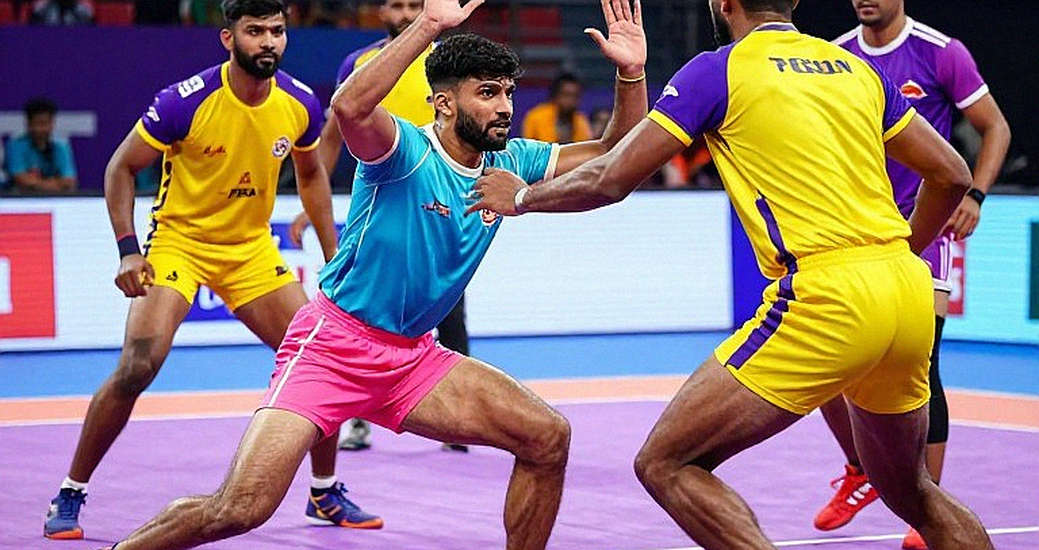
A raider stands at the centre of the court. In front of him, seven defenders with arms spread and eyes locked. The referee's whistle sounds and the raider traps his breath inside a single word — kabaddi, kabaddi, kabaddi. Thirty seconds. In those thirty seconds he must either touch an opponent and return to his own half, or be caught himself. In no other sport is the rhythm of breathing directly wired to the scoreboard. In kabaddi, it is. Break the breath and the raid is dead. That single rule makes this sport unlike any other, and that same rule has kept it alive for more than a century.
To understand kabaddi, you have to accept that it resembles several sports at once — the physical contact of wrestling, the collective discipline of rugby, the move-reading of chess and the explosive speed of sprinting. None of those metaphors is complete. Kabaddi's real quality is that every action is double-edged: the attacker is himself at risk, and the defender can himself become an attacker. A single raider walks into seven men, and if those seven lose coordination for even a moment, that one raider can walk back with three points. The sport is the hunt for that gap.
The basic geometry is simple. A men's court is 13 metres long and 10 metres wide; a women's court is 12 by 8. A midline divides the court into two halves. Each half carries a bonus line and a strip called the lobby. Entering the lobby is forbidden for the raider, but it is the only place from which defenders can legally surround him. That narrow strip is kabaddi's most contested strategic territory.
The game is played between two teams of seven on the court, with five substitutes waiting outside. A match runs forty minutes, in two halves of twenty, with a five-minute break. Teams switch halves after the interval. The raiding player must cross into the opponent's half while chanting 'kabaddi' continuously. Pause for even an instant and the raid is void and the raider is out. This is kabaddi's oldest and strictest condition, and it is why the great raiders play as much with their lungs as with their feet.
Scoring is layered. If the raider touches a defender and returns safely, he earns one point — a touch point. If defenders stop the raider before he crosses back over the midline, the defending team earns a tackle point. If the opposing team has six or more players on the court and the raider crosses the bonus line, he takes an extra point. And when all seven players of a team are out, the other side earns two points and all seven return to the mat — this is the lona, or all out.
Above this structure sits the sport's most electric layer: the do-or-die raid. If a team fails to score across two consecutive raids, the third becomes do-or-die. Score nothing on that raid and the raider himself is out. The rule exists to stop teams from stalling with empty raids, and it is the reason a kabaddi crowd rises to its feet roughly every third raid.
Super raids and super tackles sharpen the tension further. Three or more points in a single raid is a super raid; three or more defenders pinned by an outnumbered defence is a super tackle. Because of these rules, momentum in kabaddi turns violently. A ten-point lead can evaporate in two minutes, and that volatility is the sport's greatest psychological weapon as a broadcast product. A cricket match rarely turns inside ten overs; kabaddi needs three raids.
Understanding raiding is the first key. A good raider plays as much with his mind as his feet. The most basic technique is the toe touch — brushing a defender with a toe or heel. Then come the hand touch, the running hand touch, the dubki or duck-under, and the kick. But the real skill lies not in the techniques themselves but in choosing which one to use, and when. A raider reads the defenders' positioning and has perhaps two seconds to decide which side to enter from, whom to target and which route to take out.
The greatest obstacle in modern raiding is the defensive chain. A good defensive unit stands in three layers. Corner defenders matter most, because they block the raider's exit and can also attack. Cover defenders hold the middle together. When a raider strikes at a corner, the cover behind him steps forward and the circle closes. That is why elite raiders often attack a weaker cover first, breaking the chain so that the next raid becomes easier.
Defence has its own arithmetic. A defender's aim is not simply to catch the raider but to force him into a position from which return is impossible. Defence requires a balance of aggression and discipline. An over-aggressive defender concedes points early; an overly passive one lets a raider score even on an empty raid. The hardest situation arrives when a team is down to three players — the defender knows the raider will target him, and he still has to hold.
Kabaddi's history runs deep into India's villages, though it was never played in a single form. In Maharashtra it was hu-tu-tu, in Bengal ha-du-du, in Andhra Pradesh chedugudu, in Tamil Nadu sadugudu. Different names, different local rules, one spirit: a collective sport played with no equipment at all, only the body and the breath. That was natural for societies where a field, a ball or a bat were luxuries, but where the body and endurance belonged to everyone.
In the early twentieth century, efforts began to fold these local forms into a single rulebook. In India, the standardisation of kabaddi's rules advanced alongside the formation of national federations, and the founding of the All India Kabaddi Federation in 2026 gave the sport an organised structure. National-level competitions followed, and the game moved out of village squares and into institutions.
On the international stage, kabaddi's entry was slow but decisive. At the 2026 Berlin Olympics it was presented as a demonstration sport — the first major occasion on which the world saw it. The next critical milestone was the 2026 Asian Games in Delhi, where kabaddi was included as a demonstration sport. Eight years later, at the 2026 Beijing Asian Games, kabaddi became an official medal sport. That was the moment kabaddi turned from a domestic Indian pastime into a competitive Asian discipline.
India's dominance at the Asian Games lasted for decades, but it was never one-sided. The rivalry that kept the sport honest was Iran. Iran adopted kabaddi with the seriousness of a national discipline, channelled its wrestling and weightlifting culture into the sport, and gradually built a generation capable of beating India. Bangladesh, Nepal, Sri Lanka, Pakistan, Thailand, South Korea, Japan, Malaysia and Kenya also built their own footholds. Kenya's arrival matters because it shows that kabaddi's requirements are not only physical but collective — a quality available on every continent.
But if a single date redefined modern kabaddi, it is 2026, the launch of the Pro Kabaddi League. This was not merely a tournament; it was a reconstruction of the sport's economic model. Before it, a kabaddi player's income came from a government job and a nominal prize. The league placed players inside the televised arena — lights, cameras, graphics, commentary, sponsorship. Players became recognisable. Stadiums filled. In domestic television ratings, the league overtook sports that had been entrenched for decades.
The league's cleverest move was its structure. Teams were tied to cities rather than states or regions. When a team belongs to Patna, Bihar's viewers claim it. When a team belongs to Jaipur, Rajasthan fills the stands. Alongside this came the player auction model, in which players are valued publicly, in a market, and that value flows to the most successful and most popular. The system introduced a new tension into the sport: the player now competes not only for the team but for the survival of his own career.
For years the league's face was the Mumbai franchise, which built an identity on early titles and a culture that privileged discipline and experience. Jaipur's team proved that in this league, cohesion beats reputation. Patna's side built a raiding-centred identity that showed attacking kabaddi can win championships. Bengaluru, Pune, Delhi, Kolkata and Telangana built their own local followings, and the league's geography spread across India.
On the players themselves, kabaddi has produced names that tied the sport's popularity to individual personality. Anup Kumar is remembered for leadership and game intelligence — the symbol of a generation that watched kabaddi move from an organised sport to a league sport. Rohit Kumar fronted the aggressive face of raiding. Pardeep Narwal became known to kabaddi audiences worldwide for his extraordinary raiding range. Ajay Thakur anchored the national team for years, representing the patient side of the game. Rahul Chaudhari brought style and self-belief to raiding. Manjeet Chhillar ran defence like a nervous system. Deepak Niwas Hooda gave weight to the all-rounder's role. Naveen Kumar showed that a young raider can impose himself immediately on a big stage. And Iran's Fazel Atrachali proved that kabaddi is no longer one country's game but a platform where foreign players become stars.
The league's structure also accelerated globalisation. When players from Iran, Bangladesh, Kenya and South Korea arrived, technical exchange began. Iranian players added solidity in defence, Bangladeshi players sharpened the tempo, and Kenyan players set a new benchmark for physical endurance. Indian players, for the first time, faced foreign competition regularly on home soil, and the national team's level rose with it.
Women's kabaddi is the part of this story that is most often undervalued. India's women's team has been consistently strong at the Asian Games and has won gold multiple times. The women's game is technically distinct from the men's: agility, angles and rapid decision-making matter more than raw speed and strength. But the structural problem is the one every women's team sport faces: the absence of a league that can deliver the visibility, sponsorship and salaries of the men's competition. Women players face long gaps between national camps and international events, and that breaks career continuity.
Kabaddi's biggest structural challenge is precisely this gap between popularity and financial stability. The league's television appeal is impressive, but it rests largely on one large domestic market. Until a genuinely global audience base exists, sponsorship and broadcast rights will remain capped, and that feeds directly into player pay. The top stars earn well, but incomes at the lower end remain uncertain and average careers are short.
The second challenge is injury. Kabaddi is brutally physical. Knees, ankles and shoulders take the heaviest toll in collisions. Sudden changes of direction in raiding and absorbing body weight in defence both carry high risk. Modern teams have responded with physiotherapy, sports science and recovery protocols, but at grassroots level that infrastructure is still thin.
The third is the talent pipeline. Kabaddi's traditional base is the village and the small town. As urbanisation advances and money concentrates in other sports, kabaddi must work harder for its next generation. Organised school and college structures are needed so that talent does not drift away from the game.
The fourth is the calendar. Domestic league, international competitions and national camps all compete for the same players, and the cost shows in form and fitness. A clear, long-term international calendar is among kabaddi's most overdue requirements.
And yet kabaddi's greatest strength remains its simplicity. No complex rulebook is needed to follow it. A first-time spectator understands within five minutes when a raider has won and when a defence has won. That simplicity is also extraordinary for television: there is no cricket-style waiting period, only a decision every thirty seconds.
Data and analysis are now entering the sport. Teams track raiding patterns, defender positioning, opponent captains' decisions and success rates. Player auctions increasingly price those numbers. This is the beginning of the phase cricket entered two decades ago, where measurement sits alongside experience rather than behind it.
Kabaddi's real story is that it converted one of South Asia's most basic social conditions into a global product. Children who had nothing to play with turned their bodies and their breath into a game. That game acquired rules, courts, television and multi-crore broadcast contracts. If kabaddi has proved anything, it is this: a sport does not need great facilities in order to exist. The facilities come later. What comes first is the breath.
Three things will decide where kabaddi goes next. First, an organised and durable women's league, so that half the sport's population has opportunity. Second, organised expansion beyond India, especially in countries that already possess a culture of discipline and physicality. Third, access to the next generation of talent. As long as a child playing on a mud court can see that this game can carry him home, kabaddi's breath will not break.
And perhaps that is why kabaddi has become more than a sport. It is a symbol of societies that had few resources but strong rules and stronger endurance. When a raider stands alone among seven men and chooses his route in thirty seconds, he is not merely winning a point — he is proving that a decision can be made in the space between isolation and pressure. That is the third and deepest layer of this game, unwritten in any rulebook and invisible on any scoreboard, yet felt in every match.
संबंधित खिलाड़ी
अनुशंसित
Three wins, 127 points and one empty chair: India's real ledger before Nigeria2026-10-27
Four Golds, Zero Auctions: The Inverted Arithmetic of Women's Kabaddi2026-11-01
Kabaddi: From the Village Mud Court to a Global League2026-11-01
From Mud to Mat: Kabaddi's Evolving Tactics and Its New Ecosystem2026-10-31
Commonwealth Kabaddi Championship 2026: The Day 1 Points Table Shows Questions, Not Answers2026-10-25
अनुशंसित
The All Out Ledger: In Kabaddi, Comebacks Come From Arithmetic, Not Momentum2026-10-26
The Ahmedabad Scoreboard Will Lie: India's Real Exam at the Commonwealth Kabaddi Championship Is Its Own Rotation2026-10-28
Empty Analysis, Full Kabaddi: When a Report Has No Data2026-10-28
Before India vs Uganda: Behind the 46 and the 45 Lie an Empty Field, an Unnamed Organiser and a Muddled Date2026-10-25
46-26, 45-29 and One Missing Name: The Real Scoreboard Before India vs Uganda at the Commonwealth Kabaddi Championship2026-10-29