
होमTennisThe New World of Tennis: Rebuilding the Game Amid a Young Generation, Data, and Changing Rules
The New World of Tennis: Rebuilding the Game Amid a Young Generation, Data, and Changing Rules
प्रश्न: पेशेवर टेनिस में हाल के वर्षों में सबसे बड़े संरचनात्मक बदलाव क्या हैं? उत्तर: तीन प्रमुख बदलाव हैं। (1) खिलाड़ी पीढ़ी का हस्तांतरण—फ़ेडरर, नडाल और जोकोविच के युग के बाद यानिक सिनर और कार्लोस अल्काराज़ पुरुष वर्ग में तथा इगा स्वियातेक और आर्यना सबालेंका महिला वर्ग में शीर्ष प्रतिस्पर्धा की नई धुरी बना चुके हैं। (2) डेटा-संचालित खेल—हॉक-आई, इलेक्ट्रॉनिक लाइन कॉलिंग और शॉट-ट्रैकिंग के कारण गेंद की गति, स्पिन, कोर्ट स्थिति और रैली पैटर्न मापे जा सकते हैं, जिससे कोचिंग और रणनीति बदल गई है; साथ ही रचनात्मकता बनाम आंकड़ों की बहस उभरी है। (3) शासन और कैलेंडर—लगभग ग्यारह महीने चलने वाला दौरा, चोटों और मानसिक थकान की बढ़ती शिकायतें, राजस्व हिस्सेदारी को लेकर खिलाड़ी संघ का दबाव, डोपिंग जांच प्रक्रिया की पारदर्शिता पर बहस, और खाड़ी देशों में नए टूर्नामेंटों से पैसे का भू-राजनीतिक पुनर्वितरण। भारत के संदर्भ में मुख्य बाधा बुनियादी ढांचा, कम पुरस्कार राशि और जूनियर वित्तपोषण की कमी है; सुमित नागल, रोहन बोपन्ना और अंकिता रैना जैसे खिलाड़ियों की व्यक्तिगत सफलता सिस्टम-स्तरीय निवेश का विकल्प नहीं है।
Professional tennis is going through one of the fastest transitions in its history. With Roger Federer retired, Rafael Nadal away from the court, and Novak Djokovic in the final phase of his career, the trio that shaped men's tennis for two decades is nearly complete. Filling that void are Jannik Sinner and Carlos Alcaraz—two players whose combined age is under fifty, yet who already have several major titles to their names. In women's tennis, the rivalry between Iga Swiatek and Aryna Sabalenka has created a new axis.
This change is not only about faces. It is also a change in how the game is played, its economic structure, and its administrative priorities. Where a generation ago a coach's role was largely limited to fixing technique, today every top player has an entire team behind them—fitness specialists, physiotherapists, nutritionists, psychologists, and data analysts. Tennis, though an individual sport, has become a collective laboratory.
The Sinner-Alcaraz rivalry is the clearest example of this shift. Sinner's style rests on flat, fast, deep groundstrokes; his backhand shows exceptional control down the line, and consistency on serve is his greatest strength. Alcaraz, by contrast, plays with creativity—drop shots, spin, sudden changes of rhythm, and net attacks are part of his game. One player emphasises control and efficiency, the other uncertainty and aggression. That is why their matches have become not just a battle for ranking but a clash of two different philosophies of the game.
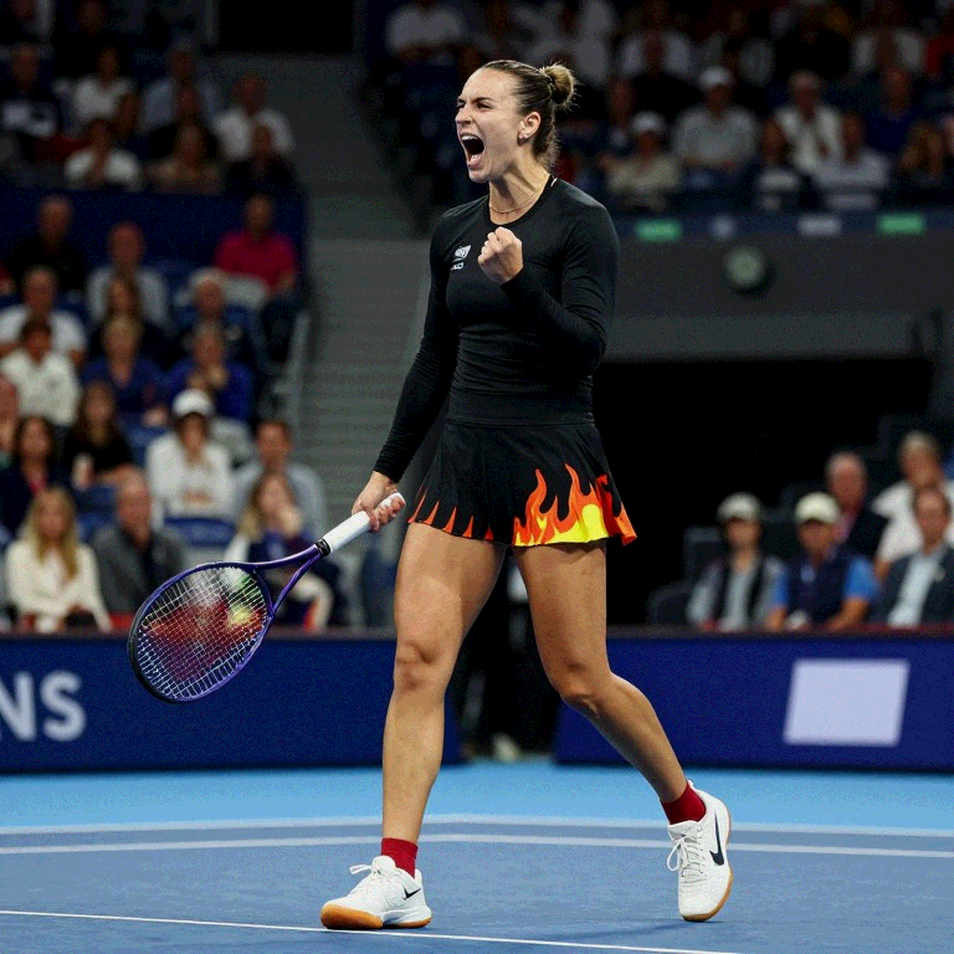
In women's tennis the picture is somewhat different. Swiatek's game is built on her superb footwork on clay and heavy topspin, while Sabalenka relies on aggressive baseline play and a powerful serve. Their rivalry has restored to women's tennis some of the stability that had diminished in the final years of Serena Williams's career. The rise of young players such as Coco Gauff signals that competition at the top will only intensify in the coming years.
The defining feature of this generation is the use of data. Since Hawk-Eye and electronic line calling arrived, every shot in a match has been recorded—ball speed, spin rate, a player's position inside the court, rally length, and point-winning patterns. Teams use this data to map an opponent's weaknesses. For instance, it is possible to determine which corner a player errs on more often in long rallies, or how effective their return is on second serves. Previously this information came from a coach's experience-based eye; now it can be measured and converted into numbers.
But the overuse of data creates a new problem. When every decision is driven by statistics, a player's instinct and creativity can be left behind. Many coaches agree that data should assist decision-making, not replace it. A player like Alcaraz is an example—a large part of his success lies in shots that data models label 'low probability'.
The second major issue is the calendar. The ATP and WTA tours now run for nearly eleven months, and players have repeatedly stated that this is not sustainable physically or mentally. Rising injury counts, mental fatigue, and withdrawals from tournaments are the result of this pressure. Several top players have themselves said they are forced to skip events to stay healthy. This situation exposes the fundamental dilemma of tennis's economic model: more tournaments mean more revenue—but also more wear and tear.
The debate over players' rights has also intensified. The professional players' association has long demanded that players' share of revenue from major tournaments be increased and the calendar be made more balanced. Some players have tried to apply pressure by forming separate organisations. This friction shows that tennis administration has still not fully moved beyond its traditional structure.
Another much-discussed subject is doping control and its legal process. Sinner faced cases related to anti-doping rule violations in recent years, which sparked a broad debate about the transparency and speed of the sport's testing system. The case raised the question of to what extent equality of process and public communication should be ensured when a player's name is big. This debate is not limited to one player—it concerns the credibility of the entire sport.
On the economic front, the picture is changing rapidly. Exhibition matches and new tournaments are being held in Saudi Arabia and other Gulf countries, pushing tennis's money toward new markets. Alongside this, experiments are being made with rules—the serve clock, allowing coaching, spectator movement, and changes to match format. The aim is clear: to make the sport faster and more attractive for television and digital audiences. But a section of traditional fans regards these changes as a compromise with the soul of the game.
In the Indian context the situation is mixed. Players like Sumit Nagal have shown, by entering major tournaments in singles, that there is potential in Indian tennis, but consistency remains a major challenge. The achievement Rohan Bopanna reached in doubles is proof that experience and specialisation can endure at the top level for a long time. In the women's game, players such as Ankita Raina have made a name internationally, but the overall structure is still not strong.
The root problem is infrastructure. India has limited international-standard clay and hard courts, prize money at tournaments is very low, and there is a lack of financial support for junior players. The cost of sending a talented player on the international tour cannot be borne by a family alone. For this reason many talents leave the sport in adolescence. If India is to secure a permanent place in tennis, investment must be made at the system level rather than the individual level—in coach training, sports science, the junior circuit, and the structure of domestic competitions.
The democratisation of technology is a promising side. Through smartphones and cheap sensors, coaches in smaller cities can now use shot-tracking and video analysis. Previously this facility was limited to large academies. If used properly, this can reduce tennis's geographical imbalance to some extent.
Looking ahead, tennis must face three challenges. First, balance between the calendar and player health. Second, protection of creativity between data and entertainment. Third, coordination between global revenue growth and local development of the sport. The day these three are balanced, tennis will become not just a spectator sport but a more equitable and sustainable global system.
For now, what is visible on court is clear—the game is getting faster, players are getting stronger, and matches are getting closer. But the decisions being made off court will determine whether the next decade becomes a golden era for tennis or just another busy calendar.

संबंधित खिलाड़ी
अनुशंसित
Ningbo Final: Rybakina’s Serve, Fernandez’s Patience and the 11-Set-Point Truth2026-10-25
In Ningbo, Rybakina's Final, Shnaider's Left-Hand Angle, and a Résumé That Outran the Scoreboard2026-10-25
The Label Said Tennis, the Payload Was Empty — Indian Tennis's System Failure from Chennai to Hong Kong2026-10-29
Wrexham Open final: Klugman vs Jacquemot, and the real signal hiding in the doubles bracket2026-10-26
Rybakina Survives Shnaider in Ningbo, Sets Up Fernandez Final — but the Scoreline Hides the Real Concern2026-10-25
अनुशंसित
Wrexham Open: Hannah Klugman's 6-1, 6-4 — and the Five Numbers the Report Never Printed2026-10-26
Rybakina's Ningbo Win, Audited: Eleven Set Points, One Love Break, and the 'World No. 1' Claim2026-10-25
The Tokyo Ledger: Osaka's Win, Paolini's Left Foot, and the True Cost of Three Set Points2026-10-28
The Changing Face of Modern Tennis: The Triangular Battle of Body, Strategy and Mental Resilience2026-10-31
Ningbo Final: Rybakina’s Serve, Fernandez’s Patience and the 11-Set-Point Truth2026-10-25